What Equipment Leasing Without Personal Credit Reporting Actually Means
Equipment leasing without monthly personal credit reporting is a financing structure in which we evaluate the creditworthiness of the business entity while also relying on the owner's personal credit bureau file to assess overall creditworthiness. This is typical for all small and medium enterprise customers. Approval decisions hinge on the asset's value, the business's cash flow, the strength of the corporate entity, as well as the owner's personal Equifax or TransUnion score. Upon entering into a lease agreement there are no further inquiries or monthly reporting to the credit bureaus.
The advantage of this type of lease structure — without monthly credit reporting — is that your personal credit report stays clear for personal borrowing for mortgages and lines of credit. Your ‘debt service ratio’ (of prime importance to banks and credit unions) remains lower because the lease acquisition costs within the business are not included.
This distinction matters because traditional bank reporting can trigger derogatory information that can lower your personal score for years. Asset-based equipment lease financing sidesteps that entirely. At LeaseDirect, we work with business owners across credit tiers from 575 to 800+, and the most common misconception is that "no personal credit reporting" means "no underwriting at all." It actually means the underwriting focus leverages support from your personal bureau to complete the most competitive deal structure possible.
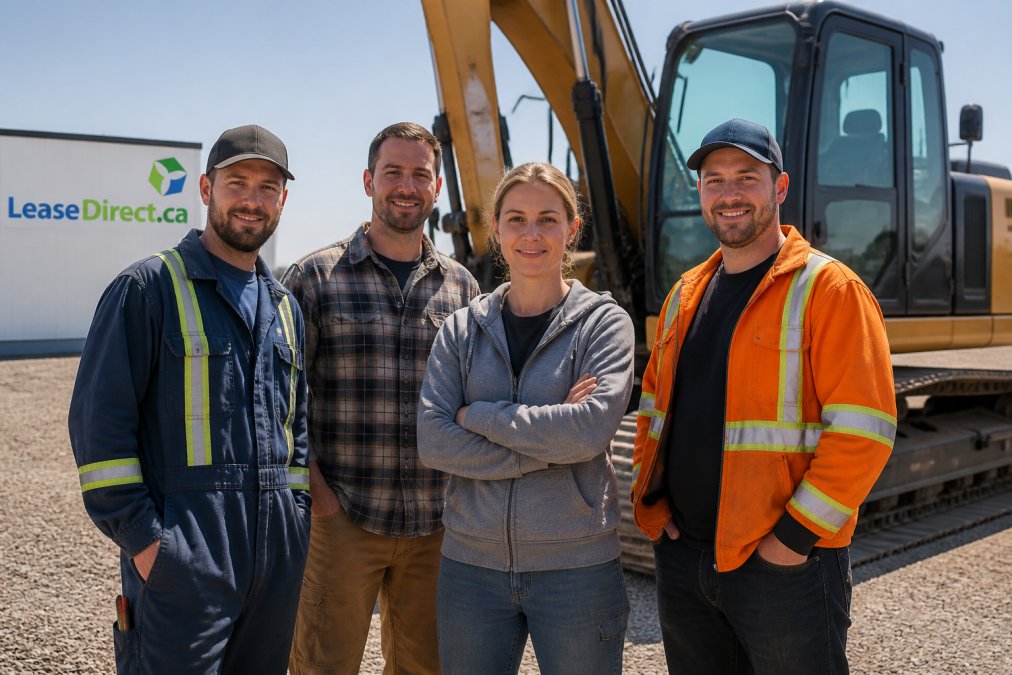
Darren Turner at LeaseDirect Canada works with small business owners to explain concepts for equipment leasing
Reality: Equipment Leasing Always Requires a Credit Check
Equipment leasing almost always involves some form of credit evaluation, but that evaluation does not have to touch your personal credit file beyond an initial inquiry. The reality is that all asset-based lenders rely on a traditional personal credit check, if only for background verfication, as a minimum. Other factors are also key to successful commercial underwriting: the asset's resale value, the business's revenue history, the strength of the lease structure, and the down payment offered.
For transactions below certain thresholds, LeaseDirect uses a simplified approval process relying primarily on asset value and basic business verification, with only a simple one page credit application and a single personal bureau pull. For larger transactions, underwriting is more thorough, including a requirement for accountant prepared financial statements, and focuses on the corporate entity along with support of the individual owner.
How Asset-Based Equipment Financing Bypasses Traditional Underwriting
Traditional bank loans use your credit score as a proxy for repayment risk. Asset-based equipment financing uses the equipment itself as the primary risk mitigation tool. If the business defaults, the lender recovers the asset. To some extent, the stronger the asset's resale value and the more liquid the secondary market, the less the lender needs to rely on the borrower's personal credit history.
This approach is documented by the Canadian Finance & Leasing Association's industry guidelines, which outline how equipment lessors assess collateral value as a core underwriting variable. Asset-based lenders are often willing to finance used equipment, specialized machinery, and vehicles from private sellers or auctions, where traditional banks will not go.
Lease-to-Own vs. Operating Lease for Building Commercial Credit
An operating lease is essentially a long-term rental. The lessee uses the equipment, makes payments, and may return the asset at the end of the term. There is optional ownership transfer. based on a residual value. Monthly payments are typically lower, and the business can upgrade to newer equipment at the end of each term.
A lease-to-own agreement (also called a finance lease or capital lease) is structured so that the lessee builds equity in the asset over the repayment schedule. At the end of the term, the business exercises an option to purchase the equipment, often for a nominal amount. For businesses still building their commercial credit, this structure is particularly valuable because it builds both asset ownership and business trade credit history simultaneously.
Feature
Operating Lease
Lease-to-Own
Ownership at term end
Optional (higher residual payout)
Yes (nominal option to purchase)
Monthly payment level
Lower, due to principal deferment
Slightly higher
Balance sheet treatment
Off-balance sheet
Capitalized or off-balance sheet
Best for
Short-term or upgrade cycles
Long-term asset retention
Business credit building
Limited to trade history
Strong, within an underwriting group
Down payment required
Often none
Sometimes required on older gear
Many growing businesses start with a lease-to-own structure specifically because it creates a clear path to full ownership without requiring a large capital expenditure upfront.
Business Equipment Financing Requirements When Credit Is Not the Primary Factor
The biggest mistake business owners make is assuming that because LeaseDirect does not focus only on personal credit, the approval process is casual. The underwriting criteria simply shift to four other core areas: the asset itself, the business's revenue history, the legal structure of the borrowing entity, and the proposed lease structure. A strong showing in all four areas can overcome a weak personal credit profile.
Income Verification and Line 13500: What Lenders Actually Review
For incorporated businesses, lenders typically request recent financial statements, bank statements covering three to six months, and the T2 corporate tax return. For sole proprietors and self-employed applicants, the relevant income figure comes from the T1 General personal tax return, specifically the net self-employment income reported on Line 13500.
According to the Canada Revenue Agency's guidance on self-employment income reporting, Line 13500 reflects net income from business activities after allowable deductions. Lenders treating this as the primary income verification tool are effectively underwriting based on demonstrated business performance rather than personal credit history. If your Line 13500 income is low because you have aggressively deducted business expenses, your stated income for lease qualification purposes will also be low.
Documentation Checklist for Low-Credit or Non-Traditional Profiles
The documentation package for asset-based equipment leasing differs from a bank loan application. Here is what some lenders will request (worst case):
Last 3-6 months of business bank statements (showing consistent revenue deposits)
Most recent corporate financial statements or T2 corporate tax return, specifically Schedules 100, 125, and 50
For sole proprietors: T1 General return showing Line 13500 net business income; the “Statement of Business Activities” schedule is better
Equipment details: make, model, year, serial number, and asking price. Photos from every angle, including engine, and hour meter.
Seller information: dealer invoice or private sale agreement. Get the seller’s GST number if he has one.
Proof of business registration (Articles of Incorporation or Business Name Registration)
Government-issued photo ID for all directors; sometime we need two pieces.
Proof of business insurance; usually $2 million in general liability plus replacement / fire / theft / damage coverages
Having some of this package ready before you apply reduces approval timelines. LeaseDirect can move from application to approval and documents in 24-48 hours when documentation is complete.
Watch OutSubmitting incomplete documentation is the single most common reason for delays in equipment lease approvals. A missing bank statement or unsigned lease agreement can add a day or two to the approval timeline. It is helpful when you prepare and submit a comprehensive package when you apply.
Step-by-Step Application Process for Equipment and Vehicle Leasing
Step 1: Identify the asset and confirm the source. Gather the equipment details: make, model, year, condition, hours, current odometer, and price. If purchasing from a private seller or auction, confirm the seller's information and obtain a copy of their original bill of sale or sale agreement. Verifying title on unregistered equipment is one of the challenges.
Step 2: Prepare your documentation package. Use the checklist above. Try to submit a comprehensive application package.
Step 3: Submit the application. LeaseDirect offers a one page application that takes under ten minutes to complete. We offer a verbal pre-approval process over the phone that can be complete in about five minutes. Call us, and let’s discuss your strengths and requirements.
Step 4: Underwriting review. LeaseDirect reviews the asset value, your business revenue, and the proposed lease structure. For deals below certain thresholds, this step can be completed the same day.
Step 5: Review the lease agreement. Before signing, confirm that all legal names are complete and correct. What is the option-to-purchase amount at the end of the term? Avoid “Fair Market Value” (FMV) end of term options, as you must negotiate the final price at that point.
Step 6: Asset inspection and funding. For used equipment or private-seller transactions, LeaseDirect may require a simple ‘desktop’ inspection (based on photos, service records, and, for vehicles, a CarFax report), or a full appraisal if the condition cannot easily be assessed. Once confirmed, funds are sent directly to the seller via EFT or direct deposit.
Step 7: Begin payments and build trade credit. Payments begin based on the agreed contract terms via a monthly auto-debit from your bank. The rental price is fixed for the term of the lease — no surprises. You know the monthly fixed cost for the machine or truck and can use that in your quotation model.
Too busy to meet? We can work via phone, text, and email, and deliver agreements through DocuSign.
Tax Implications and Cash Flow Benefits of Lease Structures
Equipment lease payments are generally deductible as a business expense under the Canada Revenue Agency's rules on business deductions, which means the full monthly payment reduces taxable income rather than only the interest portion as with a traditional loan. For businesses in higher tax brackets, this distinction meaningfully affects the after-tax cost of financing.
A lease structure spreads capital expenditure across a repayment schedule aligned with the asset's productive life, preserving liquidity for operational expenses, payroll, and growth. For lease-to-own structures, your accountant may elect to use an amortization treatment which differs from operating leases. A lease-to-own agreement may be treated as a capital lease under Canadian accounting standards, meaning the asset could appear on the balance sheet and depreciation may be claimed separately from the lease payment deduction. Consult your accountant to determine the correct treatment for your specific structure. The courts have determined that “a lease is a lease in absence of a sham option”. Working with your accountant, you can elect to go one way or the other, but once established the treatment needs to be consistent throughout the term.
Key TakeawayFor most small businesses, the combination of 100% deductible lease payments and preserved working capital makes a lease-to-own structure more cash-flow-friendly than an outright purchase, even when the total cost over the lease term is slightly higher.
How to Improve Your Credit Strength Through Equipment Leasing
Equipment leasing is one of the most accessible tools for building a trade credit profile, particularly for businesses that have been declined by traditional lenders or that have limited credit history.
Although we do not report your payment history to a commercial credit bureau, each on-time payment is recorded as a positive trade line on your file with us. Over 12 to 24 months of consistent payments, a business with no prior credit history can establish meaningful trade credit that can lead to better financing terms on future transactions.
Several practical steps accelerate this process:
Incorporate the business if you are consistently profitable, above what you need to live on. Lease trade lines attach to the legal entity.
Make payments on time, every time. Late payments on a commercial trade line are as damaging as they are on a personal file, and can delay future funding.
Apply for a second facility after a few months. A second lease may be obtained after demonstrating repayment history on the first — just send new bank statements.
LeaseDirect specializes in equipment leasing for businesses at every stage of credit development, from startups with no credit history to established companies looking to optimize their financing structure. Our team handles financing for new and used equipment from any source, including private sellers and auctions, with flexible lease-to-own terms designed to preserve your cash flow and build your trade credit profile. Call to get a verbal pre-approval in about 5 minutes and find out what your business qualifies for today.
Frequently Asked Questions
Does equipment leasing always require a personal credit check?
Yes, a personal credit inquiry is always required for small and medium enterprises that do not have extensive established commercial credit. Equipment leasing structured around asset-based financing focuses on the value of the equipment and the business's ability to generate revenue and is augmented by the owner's personal credit score. When a lease is approved under the business entity with the company principal/s individually named as co-lessees, LeaseDirect establishes a trade credit file, leaving your personal bureau untouched beyond the initial inquiry. LeaseDirect Canada explicitly structures deals this way and confirms it in the lease agreement before you sign.
What credit score is needed for equipment leasing?
Requirements vary by the age, type and condition of the equipment or vehicle. Traditional bank loans often require scores above 700, but our specialized equipment leasing programs work with business credit scores as low as 575 when the asset and cash flow support the deal. If your personal score is lower, we will weigh the equipment's value, your repayment schedule, and business revenue more heavily than the score alone. We price to risk, so a down payment or shorter contract term can also improve approval odds at lower credit tiers.
Can a sole proprietor lease equipment without it affecting personal credit?
Despite there being no legal separation between the individual and the business, there is little impact to your personal credit as LeaseDirect does not report to any credit bureau. We can structure a lease primarily around the equipment's collateral value and business cash flow, limiting personal bureau exposure to an initial inquiry only. It is not necessary to incorporate your business before applying, though doing so creates a clearer arm’s length liability structure. LeaseDirect is experienced with non-traditional credit profiles and can advise on the best structure for your situation. Starting out as a proprietorship or partnership is a less expensive option with easier tax filing implications.
What documents are required for equipment leasing?
While personal credit is not the main approval driver, it helps! When the score is suboptimal, LeaseDirect will shift focus to business financials. Expect to provide recent bank statements (typically three to six months), your most recent T2 corporate tax return or T1 with Line 13500 self-employment income, a description or appraisal of the equipment, and proof of business registration (proprietorship, partnership, or corporation). A simple one or two page business overview, with business potential and a cash flow summary, is helpful. The stronger your business documentation, the less weight the lender needs to place on your credit history.
 how-to